
[vc_row][vc_column][vc_column_text]
Māori Culture is invaluable and diverse, and incorporates traditional and contemporary arts.
General Information
Arts and crafts like the pictures of a book, are the pages of Māori culture. It’s how stories are told and passed down through generations;
how traditions and genealogy (Whakapapa) were preserved, and how history was carved and woven through the arts.
Traditional arts such as carving, weaving, kapa haka (group performance), whaikorero (oratory) and moko (tattoo)
are practised throughout the country. Māori people following in the footsteps of their tipuna (ancestors) replicate the arts used
hundreds of years ago, but also develop exciting new techniques and forms. Today Māori culture also includes art, film, television, poetry, theatre, and hip-hop.
[/vc_column_text][/vc_column][/vc_row][vc_row][vc_column width=”2/3″][vc_column_text]
Ta Moko – The Art of Maori Tattooing.
Ta Moko is a symbol of Māori integrity, identity, and prestige.
The human skin is the living canvas of a Ta Moko Artist.
The art of Moko tells the story of the person within the skin, by using a complex language of marks, made in ink and carved into the skin,
It contains the ancestral and tribal messages pertaining to the wearer. These messages narrate a wearer’s family, sub-tribal and
tribal affiliations and their within these social structures.
An ornately tattooed face was a great source of pride to a warrior, for it made him fierce in battle and attractive to women. Women were also tattooed, the lips, lower chin ( whakatehe) and on occasion the nostrils (the design represents life,
or the first breath taken by a new born baby), outlined and tattooed solid blue was considered beautiful. Other parts of the body were often tattooed but only in certain tribes, the legs were often tattooed.
Even though all facial tattoos resembled each other, no two were identical and no moko can ever be duplicated for use by another person.
Kirituhi – Skin Art put in place for the sake of non-Māori who find Moki designs attractive enough to have them tattooed on to themselves. However unlike Moko, which contains whakapapa (genealogy and history), and kaupapa (relative themes and stories), kirituhi would not hold these elements. For the wearer of kirituhi it could be for what ever reason they wanted it to be. It is also pertains to drawings on the body that can be wiped off, as seen on many modern day haka teams.
[/vc_column_text][/vc_column][vc_column width=”1/3″][vc_column_text]

Ta Moko
Ta Moko – The Story of the person within the skin.
[/vc_column_text][/vc_column][/vc_row][vc_row][vc_column width=”1/2″][vc_column_text]
Kapa Haka
Kapa Haka is one of the Traditional Māori Performing Arts.
‘Where there is movement there is life.
Where there is song, there is healing’.
Waiata – traditional chant and contemporary compositions in traditional style.
Haka – dance expressing passion, vigour and identity of the race often erroneously considered to be a war dance.
Poi – dance employing a light ball with short or long string attached swung and twirled rhythmically to the accompaniment of a song.
Waiata-ā-ringa – comtemporary action song where history and legends are retold in song and dance and waiata koroua (traditional chants).
One of the primary reasons for the continuing survival and re-energising of Māori culture, has been the introduction of tribal cultural competitions. The biennial Aotearoa Traditional Māori Performing Arts Society festival is the premier showcase for kapa haka. There are other competitions held for primary and College schools every year.
It is unique in the fact that the performers must sing, dance, with expression, as well as movement, combined into each item.
[/vc_column_text][/vc_column][vc_column width=”1/2″][vc_column_text]
Te Reo – Maori Language
The visitor to New Zealand will become immediately aware of the Māori language – Te Reo, as a majority of place names in New Zealand are of Māori origin.
Māori is the indigenous language of New Zealand, the ancestral language of the tangata whenua (people of the land) and one of the taonga (treasure) guaranteed protection under the Treaty of Waitangi.
The Māori language provides this country with a unique language identity from the rest of the world. Māori is becoming more widely spoken.
In 1987 the Māori language was named as the official language of New Zealand, along with English.
life-breath of being Māori.
Protocol
Māori have a unique protocol. The best place to observe it is on a marae (Māori meeting ground).
[/vc_column_text][/vc_column][/vc_row][vc_row][vc_column][vc_column_text]
Carvings
Carvings pay respect to the past and every carved piece tells a story. Traditional carvers versed in the oral traditions of the tribe, help to keep
Māori culture alive by creating these intricate works, which can be read by those who know how. The shape of the heads, position of the body, as well as the surface patterns work together to record and remember events.


The detailed carvings on the outside of the Te Whare Runanga Marae, from the Tekoteko – the carving of a man-like figure
on top of the Marae, to the tukutuku and kowhaiwhai patterns inside, work together to tell the history and genealogy of their iwi (tribe).
[/vc_column_text][/vc_column][/vc_row][vc_row][vc_column width=”1/3″][vc_column_text]
Pounamu
Pounamu is found in rivers on the western side of the South Island (Te Wai Pounamu, the greenstone water). Extremely hard to carve, it makes Pounamu jewellery and weapons highly treasured. Pounamu carvings inherit their own histories over time, and are known as Taonga (treasured possessions). It is valued for its beauty, and for its quality of maintaining sharp edges.

Pounamu – Greenstone.
Hei Matau
Hei Matau – Fish Hook represents prosperity, abundance,fertility and strength. Also looked at as good luck charm, especially for those travelling over water.

Hei Matau – Fish Hook.
[/vc_column_text][/vc_column][vc_column width=”1/3″][vc_column_text]
Koru
Koru represents the fern frond, and as it opens, it brings new life and purity to the world. New life, regeneration, peace and tranquility are often associated with nurturing.

Koru.
Paua
Paua is traditionally used by Māori to illuminate the eyes of their carvings. In all manner of jewellery and sculpture, Paua has become a distinctive feature of New Zealand artwork.

Paua.
[/vc_column_text][/vc_column][vc_column width=”1/3″][vc_column_text]
Manaia
The Manaia is an ancient mythical being, with a birds head and a human form. It is said to be the messenger between the earthly world of mortals, and the domain of the spirits. A holder of great spiritual energy and a guardian against evil. The Manaia is often depicted with the three fingers of birth, life and death.
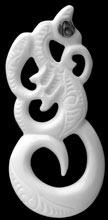
Manaia.
We would like to acknowledge Bone Art for the use of this image.
Hei Tiki
This squat rounded figure of the tiki, is believed to represent a human in the embryonic stage. Often depicted in meeting houses and on waka carvings. Known as one of New Zealand’s most famous icons. A revered and treasured possession, Māori wore hei – tiki around their necks and close to the throat, to absorb the life force of its wearer.
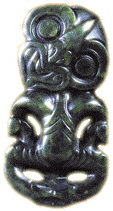
Hei – Tiki.
[/vc_column_text][/vc_column][/vc_row][vc_row][vc_column width=”1/3″][vc_column_text]

Korowai
The Korowai, a finely woven Māori cloak, is worn as a mantle of prestige and honour.
The cloak becomes empowered by the status and mana (prestige) of its owner and the mana increases when it is worn.
[/vc_column_text][/vc_column][vc_column width=”2/3″][vc_column_text]
Weaving
Weaving holds great spiritual significance within Māori Culture.
When arriving in Aotearoa, the Māori relied on the harakeke (New Zealand Flax) for weaving to meet their everyday needs.
Some protocols apply to harakeke horticulture including saying a karakia (prayer) before cutting the flax. It was scraped by hand using seashells to remove the fibre or muka. The muka was then used to make korowai (cloaks), whakatipu (rain capes), tatua (belts) and rope. Harakeke was transformed into platters to eat from, make buckets to carry soil and sand for cultivating gardens and building fortifications/ lines and nets for fishing/ mats to sleep on and to cover floors/ lashings for canoes and dwellings/ snares to trap birds/ sails for canoes,/rattles for babies/ making sandals.
The work was suspended between two upright weaving pegs and woven by hand. Feathers or decorative threads were integrated into the fabric of the garment, as the weaving progressed. Natural dyes were used to achieve a variety of colours; paru (swamp mud) was used to achieve a black tone and tanekaha (bark) produced brown. Weaving was traditionally done by women, and skills were handed down from generation to generation. Weavers were prized within their tribes.
[/vc_column_text][/vc_column][/vc_row][vc_row][vc_column][vc_column_text]
Oratory
Oratory is the food of Chiefs – Ko te Whaikorero, te kai a Te Rangatira
Traditionally, Māori was an oral culture and maintained knowledge through oratory and the spoken word.
This required an good memory for details to be passed accurately from one generation to the next. The tradition of oral history – the telling of ancient stories, myths and legends – continues today. On many marae, elders teach tribal lore, etiquette, genealogy and also tell the stories that form the basis of Māori beliefs.
Oral history takes on different versions as centuries pass and it is presented from a variety of view points. There is no right or wrong version, only different; the result is a rich range of traditions where it is impossible to summarise.
The Haka
The origins of the haka are deeply rooted in the mists of time. It is a history rich in folklore and legend that reflects Māori heritage.
The haka is a composition played by many instruments. Hands, feet, legs, body, voice, tongue, and eyes all play their part in blending together to convey in their fullness the challenge, welcome, exultation, defiance or contempt. It is disciplined, yet emotional. More than any other aspect of Maori culture, this complex dance is an expression of the passion, vigour and identity of the race. It is at its best, truly, a message of the soul expressed by words and physicalness.
Also essential to the art of haka are pukana (dilating of the eyes), whetero (protruding of the tongue performed by men only), and potete (the closing of the eyes at different points in the dance, performed by the women only). These expressions are used at various times in the performance to lend meaning and force to the words.
It was the 1905/6 All Blacks in Britain who really popularised the haka, and it was done before the first of the five test matches against Scotland..
The haka has been immortalised by New Zealand’s Rugby Team the All Blacks who perform the haka before every game.
The haka has become a truly unique symbol of New Zealand identity, and New Zealanders are increasingly recognising that the haka must be treated with respect. Today, the practice of haka goes from strength to strength and is centre stage in the resurgence of Māori Culture.
To all prospective visitors to New Zealand, I would urge you to investigate the Māori culture which is very rich indeed. In particular make sure that you see a ‘genuine’ haka performance. The sheer passion and force of a well executed haka is guaranteed to send shivers down your spine!
Matariki
The pre-dawn rising of the star cluster Matariki is significant to Māori and is referred to as ‘Te tau hou’, the new year. Matariki is the Māori name for the Pleiades, a star cluster in the constellation Taurus. Pleiades, the Greek name for the cluster, comes from seven sisters of Greek legend, the daughters of Atlas and Pleone. This is reminiscent of the Māori and Pacific stories that say Matariki is a mother surrounded by her six daughters.
The Maori new year is marked by the rise of Matariki and the sighting of the next new moon. The pre-dawn rise of Matariki can be seen in the last few days of May every year and the new year is marked at the sighting of the next new moon which occurs during June. The Matariki constellation twinkles on and off in such a way that one second you’ll see them, and another they’ll be gone. There are two translations for Matariki- mata riki, tiny eyes; and mata ariki, eyes of god.
Traditionally, Māori were keen observers of the night sky, determining from the stars the time and seasons, and using them to navigate the oceans. Lookouts would watch for the rise of Matariki just before dawn. For Māori, this time signified remembrance, fertility and celebration. In times of old, the sighting of Matariki was greeted with expressions of grief for those who had died since its last appearance. Some said the stars housed the souls of those departed. The old people might wait up several nights before the stars rose. They would make a small hāngī. When they saw the stars, they would weep and tell Matariki the names of those who had gone since the stars set, then the oven would be uncovered so the scent of the food would rise and strengthen the stars, for they were weak and cold.
The coming season’s crops were planted according to the portents read in the Matariki star cluster. If the stars were clear and bright, it was a sign that a favourable and productive season lay ahead, and planting would begin in September. If the stars appeared hazy and closely bunched together, a cold winter was in store and planting was put off until October. Traditionally, depending on the visibility of Matariki, the coming season’s crop was thought to be determined. The brighter the stars indicated the warmer the season would be and thus a more productive crop.
Matariki also happened at the end of harvesting, when food stores were plentiful. The variety of food which had been gathered and preserved ensured an abundant supply for feasting – Matariki was an important time for festivity. Women rejoiced, sang and danced to celebrate the change of season and new beginnings. Often kites (pākau) were flown – they were thought to get close to the stars.
Matariki celebrations were popular before the arrival of Europeans in New Zealand , and they continued into the 1900s. Gradually they dwindled, with one of the last traditional festivals recorded in the 1940s. At the beginning of the 21st century Matariki celebrations were revived. When the first Matariki celebrations in Hastings in 2000 were organised about 500 people attended, and in 2003, 15,000 people came. Matariki is becoming more popular celebrating Māori culture and in doing so bringingan increase in popularity of the traditional Māori kite (pākau). It is said that the ancestors of Māori, including the Polynesians of ancient history, welcomed Matariki by flying kites. A number of modern Matariki celebrations have involved making and flying kites. In a modern twist, the Hastings festival featured fireworks and hot air balloons, symbolising kites flown from the hilltops by the ancestors.
The Matariki stars were used to navigate, to keep time, know what season they were in, and to learn about the legends of the stars. Learning about family and whakapapa was also very important around the time of Matariki. It was time to come together to exchange stories, learn about ancestors who have passed from this world to the next, and hand down knowledge and practices to ensure the Maori culture is preserved.
Traditionally celebrations lasted up to 3 days after the new moon had risen following Matariki becoming visible. All Iwi (Maori Tribes) celebrate Matariki, although they may celebrate at different times. For some tribes celebrations are held when Matariki is first seen in the dawn sky, for others it is celebrated after the full moon rises, and for others the dawn of the next new moon. You could celebrate Matariki by preparing a garden in your backyard, having a family gathering to share family history and knowledge and then have a feast to celebrate the New Year.
[/vc_column_text][/vc_column][/vc_row]