
AHIPARA For Coastal Fun At The Southern Point Of 90 Mile Beach
Ahipara “Scared Fire” a seaside settlement at the southern point of the world famous 90 Mile Beach
beckons you to enjoy some good ole coastal fun.
General Information1Ahipara is a small coastal settlement 15 kilometres west of 2Kaitaia with two or three shops, a school, and a scattering of houses. An excellent vantage point for a panoramic view along Ninety Mile Beach. It is also the venue for the world's biggest snapper surf-fishing contest, held every February. ActivitiesSituated on the "Wild West Coast", Ahipara has some of the best surfing beaches in the world. Land based fishing is fantastic with great diving locations as well. Ahipara also has an 18 hole golf course which is rated as one of the best link courses in the country. Other great activities to pass the time away are: horse riding, body boarding, kite flying, hand gliding, and land yachting. During the major yearly events taking place are the $250,000 Snapper Classic in February, and the 90 Mile Beach Te Houtaewa Challenge in March. |
||
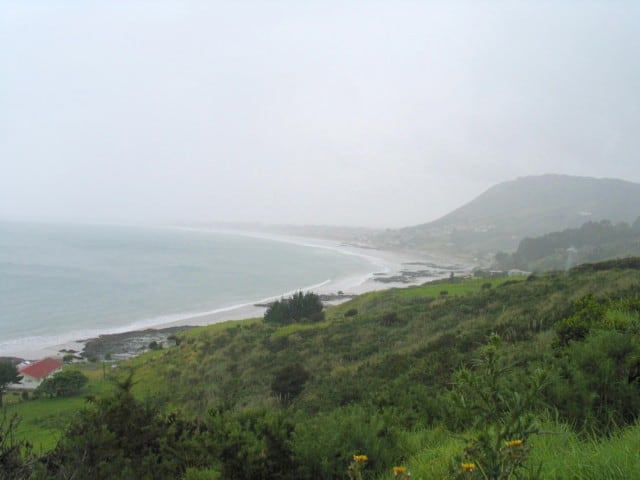
![]() Ahipara. Ahipara, 90 Mile Beach. A wet misty day creates a mystical feeling over Ahipara, the southern starting point of the world famous 90 Mile Beach.
Ahipara has a proud history of Māori settlement and is the tribal area of
the
Te Rarawa people and descendents of the waka Tinana which carried the first people here from the Pacific. Te Rarawa emphasise descent from the Tinana canoe, captained by Tūmoana. The waka (canoe) Tinana landed at 3Tauroa near Ahipara. The chief, Tūmoana, laid claim to the land between 4Hokianga and Ahipara, as far inland as the mountains 5Mangamuka and 6Maungataniwha. Later Tūmoana returned to Hawaiki, but his daughter Kahutianui and son Tamahotu remained at Tauroa. The canoe eventually returned, adzed a second time and renamed as 7Te Māmaru, with Tūmoana's nephew Parata on board. Directly descending from Tūmoana was Haupare (his great grandson) who married Paengatai; from them came Taranga. Their descendants were known as Ngati Haupare, who later became the Iwi Te Rarawa. The name Te Rarawa comes from an incident on the shores of the Kaipara Harbour. Te Ripo, a high-born woman, was killed by a war party from the Kaipara. An avenging party led by Ngāmotu pursued the warriors south to Kaipara Harbour. However, the fleeing party crossed the harbour to their pa at Okika. They performed incantations, making the waters of the harbour too rough to cross. Frustrated, Ngāmotu’s people raided a cemetery on the shores of the harbour, removing the remains of a deceased priest. They burnt the remains and threw the ashes into the harbour to calm the waters. They also ate part of the body. Toko, an old woman who witnessed these events, exclaimed, ‘Kātahi anō te iwi kai rarawa!’ (Who would have heard of such cannibalism?), and ‘Te rarawakaiwhare!’ (The people consume all!). Te Rarawa then became the tribal name. |
St Clements Church at Ahipara dates back to 1872 when the Kauri gum, left from the forests that had been logged was attracting waves
of settlers. The Gunfields Historic Reserve above Ahipara is a small area of the original gumfields that has been preserved as it
was when the gumdiggers were working the land. Late nineteenth century most of the inhabitants of Ahipara and Kaitaia had some
connection with the gumdigging industry. At their peak in the early 20th century the gumfields, on a remote sandy dune plateau to the south of the town, supported three hotels and two thousand people. Unlike most fields, where experimental probing and digging was the norm here the soil was methodically excavated, washed and sieved to extract the valuable kauri gum. None of the machinery or the dwellings remain on the plateau, but gum can still be found - particularly in the stream that washes down into shipwreck Bay - and the gumfields make an eerie, desolately beautiful place to explore. Once an area had been logged, the gum diggers typically moved in. Like most pines, kauri exudes a thick resin to cover any scars inflicted on it, and huge accretions form on the sides of trunks and in globules around the base, further hardening off in time. In pre-European times, Māori chewed the gum, made torches from it to attract fish at night and burned the powered resin to form a pigment used for moko (traditional tattoos). Once Pakeha got in on the act, it was exported as a raw material for furniture varnishes, linoleum, denture moulds and the “gilt”edging on books. When it could no longer be found on the ground, diggers – mostly Damation, but also Māori, Chinese and Malaysian- thrust long poles into the earth and hooked out pieces with bent rods; elsewhere, the ground was dug up and sluiced to recover the gum. Almost all New Zealand gum was exported, being shipped out to coastal steamers from the beach. But by the early twentieth century synthetic resins had captured the gum market. Kauri gum is still considered one of the finest varnishes for musical instruments, though prices don’t justify collecting it, occasional finds supply such specialist needs |
|
|
1 Ahipara is ‘Sacred
Fire’.
This fire was kept constantly burning for the village, on the ground where the school is now located. 2 Kaitaia: Kai – food taia – neap, of the tide |
3 Tauroa:
Tau –ridge of hill roa –long 4 Hokianga: Great returning place of Kupe 5 Mangamuka: Manga – stream muka – shoot of nikau |
6 Maungataniwha:
Maunga – mountain taniwha –monster Māori name for Mount Camel 7 Mamaru: One of the many canoes that migrated from Hawaiki |