
General Information
Punakaiki lies halfway between Greymouth and Westport on the West Coast of New Zealand, in the Buller District. Punakaiki is home to the dramatic and awe-inspiring limestone country of the Paparoa National Park and is best known for its spectacular Pancake Rocks and Blowholes.
Attractions and Activities
Punakaiki is centred in the Paparoa National Park. With its varied landscapes, from native forests, mountaintops, caves, underground streams, limestone cliffs and canyons; there’s adventure activities just waiting for you.
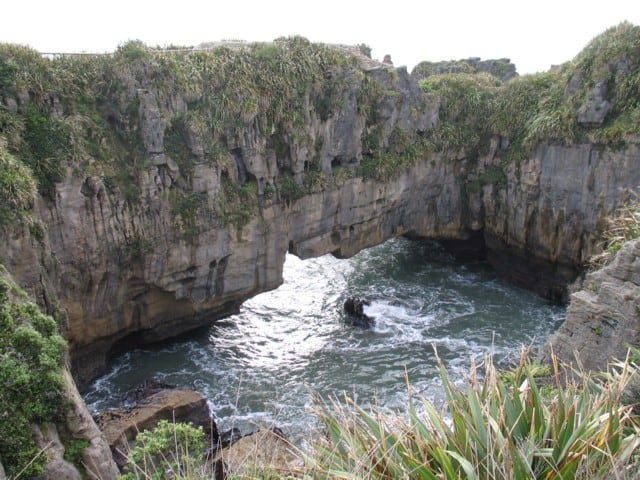
Punakaiki, Buller, South Island, New Zealand 2
Surge Pool.
A trip to the West Coast wouldn’t be complete without seeing the amazing, natural limestone formations that began forming 30 million years ago. They were created when layers of soft mud and clay settled on the lime-rich fragments of dead marine creatures on the seabed. Earthquakes then raised the seabed above sea level, forming coastal cliffs and coastline. Over time the shapes have changed by wind, rain and sea, which have etched out the softer layers to represent what we see today. The limestone formations have created caverns below them, where water gushes through. In some areas a blowhole is present. When conditions are right, heavy ocean swells roar into the caverns, blasting a spectacular spray of water skywards, through the blowhole.
Hector’s Dolphin or New Zealand Dolphin are the world’s smallest dolphins, as well as one of the rarest marine dolphin with less than 4000 animals remaining. Nevertheless, because it lives fairly close inshore it can sometimes be seen from the coastal headlands around Punakaiki.
The Park offers caving for all levels of experience. The Punakaiki Cavern and Fox River Tourist Cave require a torch and good footwear. They are open to the public and cater for the beginner. For the experienced cavers try Babylon, Xanadu, Armageddon, Kubla Khan/Cairns Catacombs, Abyssinia, Cataract Pot/Myopia or the Cave Creek Cave. Some caves require special entry permits and are accessible to the public only by guided parties.
A great place to go canoeing in The National Park is down the easy flowing waters of the Pororari River through lush rainforest.
There are many walks of varying lengths and degrees of difficulty around Punakaiki and within the Paparoa National Park.
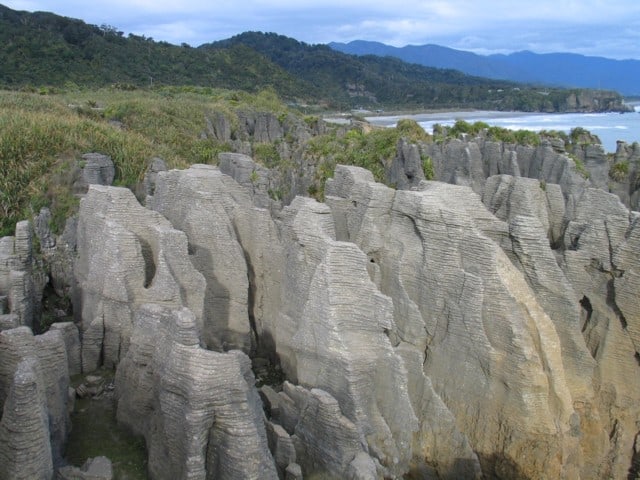
Punakaiki, Buller, South Island, New Zealand 3
Pancake Rocks.
A short walk suitable for families, to view the Pancake Rocks and Blowholes.Punakaiki River to Pororari River Loop
A short walk visiting limestone cliffs and canyons.
From the end of Bullock Creek Road a track will take you to where the creek emerges from the deep underground cave system. It is an easy 2 hour return walk.Truman Track
A popular 1hour return walk a few minutes drive north from Punakaiki, at Te Miko. The walk takes you through sub-tropical rainforest of ferns, nikau palms and rimu out to the coastal headland.Punakaiki Cavern
Five minutes walk north from the Pancake Rocks walkway is the Punakaiki Cavern, hidden away on the eastern side of the main road. The cavern features glow worms and stalactites.
This short track will reward you with fascinating views of karst limestone country, while walking alongside the Pororari River to meet with the Bullock Creek.Mt Bovis (1252m)
A day walk to Mt Bovis with its extensive views over the park and the Paparoa Range is challenging. Requires a good level of fitness with some steep sections to reach the summit.
Pororari River Track
The starting point for this track is at the bridge crossing at the Pororari River, one kilometre north of the Department of Conservation (DOC) Visitor Centre. It is a 2.5 hours return walk through the Pororari River Gorge and Valley with its towering limestone cliffs and bluffs. The Valley features dense sub-tropical forest of tree ferns nikau palms, coastal broadleaf plants and towering rata.
The track starts at a small settlement in Fox River, 12km north of Punakaiki. The 1-hour walk will lead you to the caves where you’ll see stalactites and stalagmites. A torch is a must as well as suitable footwear. One hour further down the track, you will reach the unique overhanging cliff face, the Ballroom Overhang.Inland Pack TrackThis historical 25km track was created in the mid 1800’s by goldminers to transport gold. The two days walk starts at the southern end of the track nearest Punakaiki and ends north towards Fox River. The entrance is 1km south of Punakaiki follow the gravel road and look for the signs.
The track can be broken into three sections. The first two sections should be covered in the first day, culminating at the Ballroom Overhang, where it is recommended you spend the night. There are no huts along the track, and it is advised that you take a tent.
This track features all the natural wonders that the Paparoa National Park has to offer.
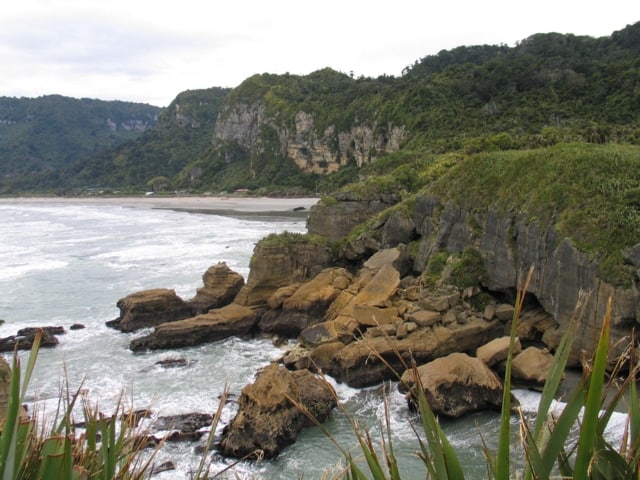
Punakaiki, Buller, South Island, New Zealand 4
Punakaiki settlement, beach and evidence of natural coastal erosion.
Shopping
Punakaiki is the service centre for the Paparoa National Park. The township has a Department of Conservation (DOC) visitor centre, café and tearooms, craft shop and plenty of car parking. All amenities can be purchased in the township.
Punakaiki has many colourful local crafts people – jewellers, carvers, painters and potters.
Maori Translations
Poro – block, broken off
rari – Make an uproar, disturbance
Punakaiki:
Puna – hole
Kaiki (a misspelling of Kāike or Kāika)
– to lie in a heap
Paparoa: large expanse of level land or long flat rock